


ThinkCraft AI is a free app that teaches artificial intelligence through five-minute, game-style lessons, and it made national news this week. Its founder, a teenager from Kerala known as the “AI Kid of India”, spoke to Vladimir Putin in Moscow on 26 November 2026. This explainer skips the selfie and looks at the product, his argument, and what it means for schools.
Every claim below is attributed. Where only the company or the founder has said something, we say so. The main source is the Kremlin transcript of the meeting, and for the app itself we use the official ThinkCraft page and the App Store listing.
ThinkCraft AI at a glance
- What it is: a free learning app for iPhone and Android, built by Raul John Aju’s Kochi company AIRealm Technologies.
- Who it is for: school students from Class 6, plus college students and professionals, according to ThinkCraft.
- How you learn: short lessons, videos, quizzes, games, XP and certificates.
- The big idea he pitched in Moscow, alongside ThinkCraft AI: learn the basics first, then use AI.
- What is unverified: the headline training numbers, the government work and the other tools. We cover each below.
Who is Raul John Aju? Only the facts that matter
Raul John Aju is a teenage entrepreneur from Kerala. The Kremlin transcript has Sber CEO German Gref introducing him as being “17 years of age”, while some Indian outlets say 16, so we simply say teenager. He is the founder of AIRealm Technologies and the person behind the ThinkCraft AI app.
He is a minor, so this article deliberately leaves out his school, family and personal details. The story here is the technology and the policy argument, not the person.
What is ThinkCraft AI and how does it work?
According to its official ThinkCraft page, ThinkCraft AI is “Duolingo, but for learning AI”. You open the app, read a five-minute story lesson, answer a few questions and earn points. The app lists these building blocks:
- Story lessons: short, visual explanations where a character called MeBot acts as the tutor.
- Practice arena: games such as AI Detective, True or False, Speed Quiz and Pattern Match, plus one-on-one duels with friends.
- Video courses: three free courses, including a 30-Day AI Challenge that starts from “what even is AI”.
- XP, streaks, leagues and certificates: the same habit loops that language apps use.
- Learning paths: school lessons for Classes 6 to 8 that follow the CBSE AI chapters (ThinkCraft counts 203 lessons), and career tracks for AI Engineer, Data Scientist and ML Engineer.
The App Store listing adds two useful details. Each lesson is meant to take 5 to 7 minutes and “ends with something you can actually do”. It also says the app is a curated lesson library and has no tools to create images or videos. Topics named there include prompt engineering, bias, algorithms and media literacy.
So ThinkCraft AI is not a chatbot or an AI model. It is a course app about AI. That distinction matters when you compare it with tools such as ChatGPT or Gemini, which we compare in our guide to Gemini vs ChatGPT vs Perplexity in India.
Is ThinkCraft AI really free?
ThinkCraft says every lesson, game and video course is free. The App Store lists the app as free with in-app purchases, so check what the paid options are before a child pays for anything. For schools, ThinkCraft AI offers a free three-month pilot; after that it says it agrees a price with the school in writing first.
The Kremlin transcript: learn the basics before using AI
The most useful part of the meeting is not the photo. Putin asked Raul about a real worry: young people may let AI write for them and stop thinking, or even stop wanting to memorise anything. Raul’s answer, as recorded in the transcript, was that students should “collaborate with AI rather than just use it to replace the whole thing”.
He used a calculator comparison. In his words, in India students are not supposed to use calculators up to tenth grade, so they learn maths, and only after eleventh and twelfth, “once we have learnt the basics”, can they use them. He proposed the same pattern for AI:
- Teach AI as a separate subject from around sixth grade.
- After tenth grade, have students write their English essays first.
- Only then teach them how to use AI for the same task.
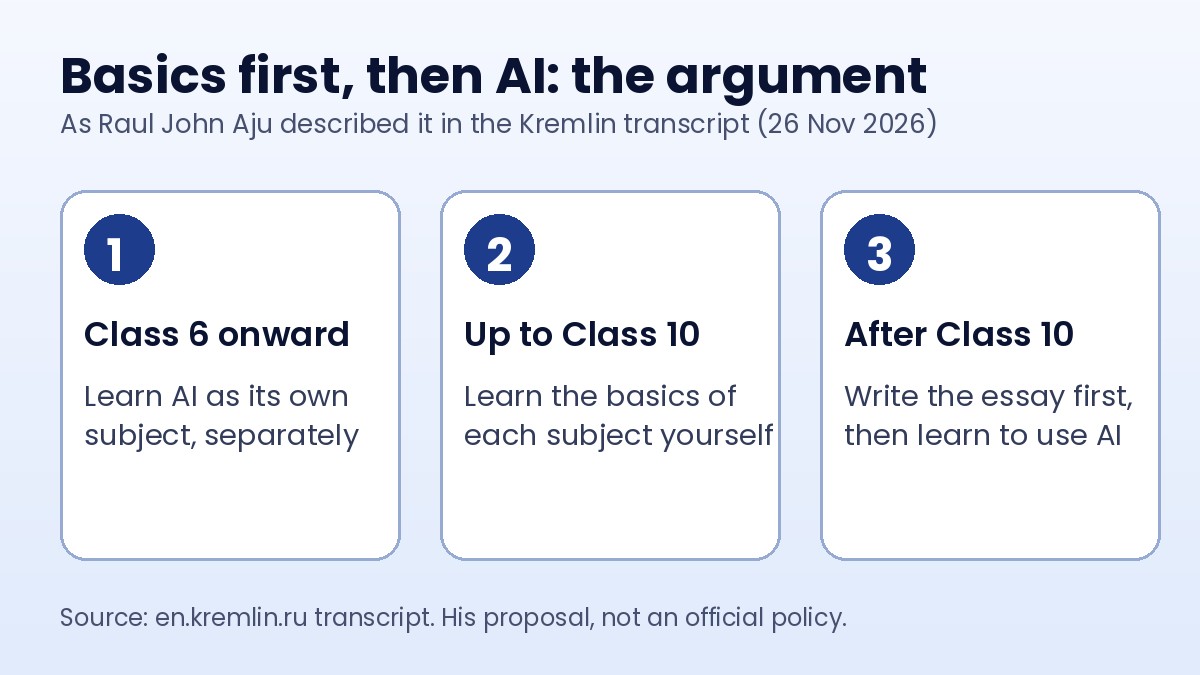
He also argued for teaching how to derive an equation instead of memorising it, and for teaching children how to come up with new ideas. In his view that is “where AI lacks and where humans can stand out”.
What he said about teachers
Earlier in his remarks he said he is “not talking about replacing teachers”. He argued that in a class of 40 a single teacher cannot personalise lessons for every child, and that an AI tutor could help, for example by explaining in a child’s own language. Teachers, he said, teach children “how to think rather than what to think”.
What Putin replied
Putin’s closing comment, quoted from the transcript, was: “Ultimately, what you are doing contributes to the implementation of Prime Minister Modi’s Make in India initiative by helping young people come up with solutions of their own and put them into practice.” That is Putin’s characterisation. India’s government has not made any statement about the meeting that we could find.
What this means for AI in education India
The “basics first” argument behind ThinkCraft AI is a proposal from one young founder, not a policy. Still, it lands in a country that is already deciding how AI should enter classrooms. This is the practical context for AI in education India, and for where ThinkCraft AI fits.
CBSE circular Acad-18/2026, dated 9 April 2026, releases a Computational Thinking and AI curriculum for Classes 3 to 8, with the stated aim of creating AI-literate learners by 2030. The framework builds computational thinking first and introduces AI later, once that groundwork exists. In other words, the official approach is also “foundations first”, though it does not set any rule about essays or calculators. You can read the CBSE circular yourself.
Here is how parents and teachers can use the idea without waiting for a rule:
- Draft first, ask AI second. Let a child write a first version of an answer, then use AI to find gaps. Our guide to free vs paid ChatGPT and Gemini for students has more on honest use.
- Treat AI literacy as its own skill. Learn what AI gets wrong, how bias creeps in and how to spot fake media.
- Ask where the answer came from. A tutor that cannot show its working is a shortcut, not a teacher.
- Keep the teacher central. Raul himself argued against replacing teachers.
There is also a fair counter-argument. Some researchers and teachers say students learn how to use AI well by using it early, with guidance. Nobody has settled the ideal age. Treat Raul’s Class 6 and Class 10 markers as a starting idea to test, not a finished curriculum.
Child data and safety checks for any AI learning app
Because ThinkCraft AI targets minors, data handling matters. On its FAQ the company says there are no ads and no tracking, and that a parent approves every under-18 account and can set a daily limit. Its schools page says it follows India’s child data law. These are the company’s statements, and we have not audited them.
The law they refer to is the Digital Personal Data Protection Act, 2023. Section 9 requires verifiable parental consent before a child’s data is processed and bars tracking, behavioural monitoring and targeted ads aimed at children, with exemptions set in the rules. Read the Act on MeitY’s site. For your own accounts, see our Windows 11 Copilot privacy checklist as a model of what to review in an AI tool.
A careful look at the other tools
Several outlets list more of his projects. The descriptions differ between sources, so here is what each source actually says, with no endorsement from us.
RESQ.AI
AIRealm’s products page calls RESQ.AI “emergency legal intelligence” that reads contracts, researches case law and connects users to verified lawyers, and lists it as active. In a UN News interview Raul described a tool that says what to do in an emergency and which laws apply. Business Standard, citing his LinkedIn, calls it a legal technology platform. Unverified: we found no independent testing of its accuracy, no user numbers and no detail on how lawyers are verified. Legal AI can be confidently wrong, so treat any output as information, not legal advice.
MeBot
MeBot is the robot that started his journey. News18 reports that it runs on an NVIDIA Jetson Nano and speaks in his voice, “like my clone”. AIRealm describes it as a physical AI avatar that mirrors his voice, gestures and expressions. It is a demo-style project, and we found no evidence of wider deployment.
The lab prototypes
AIRealm says it has more than ten experimental prototypes and names ZapGap, Investo AI and Feedfye. We found no public details on what these do or whether anyone uses them, so treat them as unverified.
How many people has he trained? Numbers differ by source
Training figures are the claim most worth checking. Here is who said what:
- Kremlin transcript, 26 Nov 2026: Gref introduced him as having trained “more than 500,000 schoolchildren and professionals”, and Raul himself said he had taught half a million people.
- News18, February 2026: Raul said he had trained nearly 1.5 lakh students.
- UN News, February 2026: he said more than seven million people have been able to learn from the ThinkCraft Academy courses.
- AIRealm’s website: “5L+ people trained”, with other reach figures such as Instagram followers, all self-reported.
These numbers are not the same measure. Some may count learners, some course views, some app users. We could not verify any of them independently, so the safest reading is: “according to him and his company”.
The same caution applies to other claims. According to UN News, he has advised the Kerala and Dubai governments, and his ThinkCraft school page lists institutions where sessions were held. We found no confirmation from those bodies. In the transcript, Raul says his students include the Government of India, but India’s government has not commented on it.
Should you or your child try ThinkCraft AI?
If your child is in Class 6 or above and curious about AI, a free app like ThinkCraft AI can be a low-risk way to start, provided you check the basics yourself. Here is a short checklist:
- Install it yourself first and go through two or three lessons.
- Review the privacy policy and the parental controls, and set a daily limit.
- Check what the in-app purchases offer before paying.
- Compare its lessons with your child’s school syllabus, including the new CBSE material.
- Use it as a supplement. Keep school fundamentals and teachers first, in line with his own argument.
The bigger lesson from Moscow is not about ThinkCraft AI alone. Whether it is ThinkCraft AI or any other tool, whatever a student uses, writing the first draft and understanding the basics themselves keeps AI in the role of an assistant. That is the part of this story worth keeping.
Frequently asked questions
What is ThinkCraft AI?
ThinkCraft AI is a free AI-learning app from AIRealm Technologies, founded by Raul John Aju. It teaches AI through short lessons, quizzes, games and certificates, from school level to career tracks, according to the official ThinkCraft page.
Who made ThinkCraft AI?
It is built by AIRealm Technologies in Kochi, Kerala, founded by teenager Raul John Aju, known as the “AI Kid of India”.
What did he tell Putin about students and AI?
In the Kremlin transcript he said students should collaborate with AI rather than let it replace their learning, learn the basics first as with calculators, teach AI from around Class 6, and write essays themselves before using AI after Class 10.
Is ThinkCraft AI officially linked to the Indian government or CBSE?
We found no official confirmation. ThinkCraft says its school lessons follow CBSE AI chapters for Classes 6 to 8, but that is the company’s own description. CBSE’s own framework is published separately on its academic site.
Are his training numbers verified?
No. The figures range from 1.5 lakh to more than seven million depending on the source and date, and all are claims made by him or his company, repeated by others.
Is ThinkCraft AI safe for children?
The company says it has no ads, no tracking and parent-approved under-18 accounts. We have not audited this, so check the privacy policy and parental controls yourself, and see the DPDP Act rules on children’s data.
Does this mean AI in education India should be banned in schools?
No. Nothing in the transcript or the CBSE framework calls for a ban, and ThinkCraft AI itself is built to teach AI, not block it. The proposal is about sequence: build the foundations first, then add AI.